Baking and desserts
Medovik honey cake
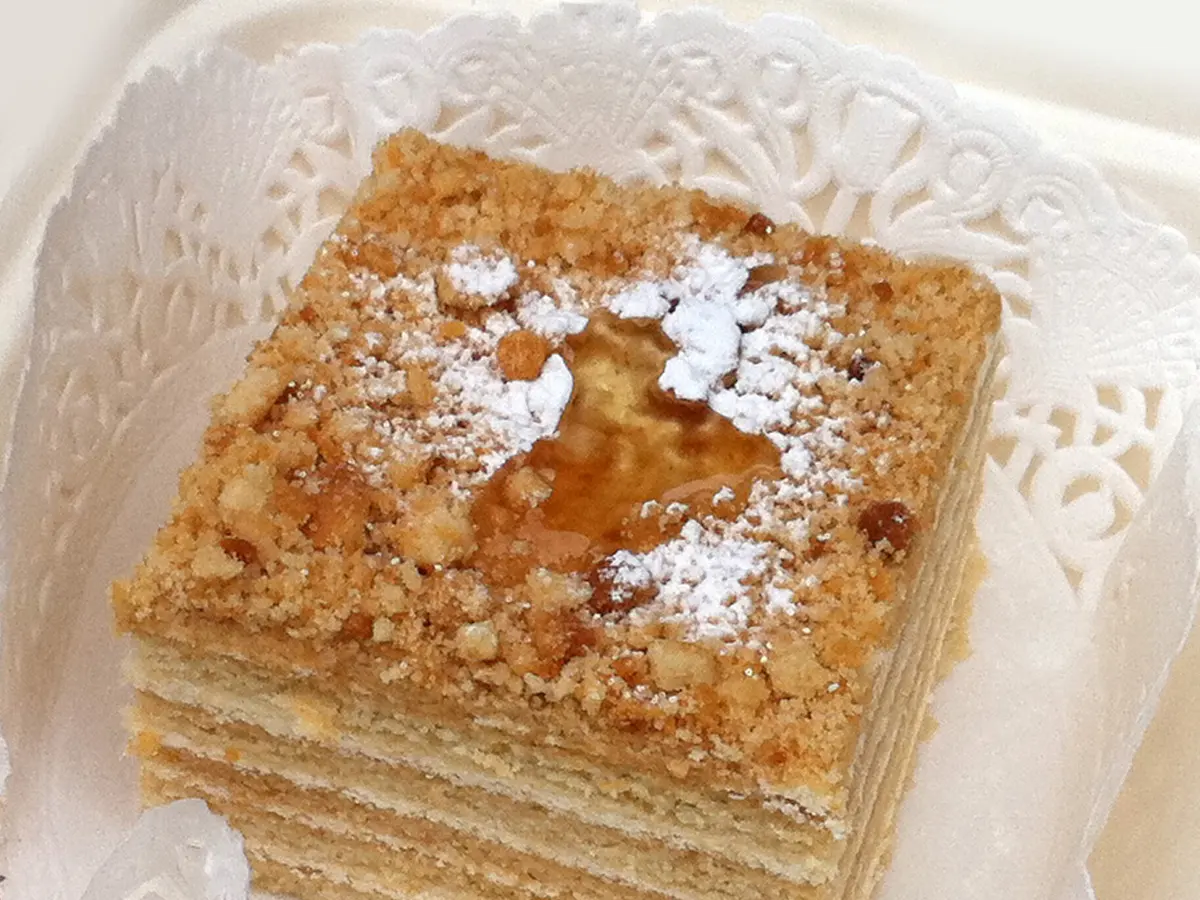
Medovik is the cake Russian mothers and grandmothers made for every celebration. Thin honey sponge layers with a caramel aroma soak up a delicate sour cream frosting until soft and almost melting. The dough is cooked over a water bath: honey, sugar and butter are melted, eggs and bicarbonate of soda are added, and the mixture puffs up and darkens. The layers are rolled thin and baked for just a few minutes each. It takes more work than an ordinary sponge, but it is worth it. The golden rule: let the cake rest for at least 8 hours, ideally overnight.
Method
Tap a step to mark it done.
In a bowl set over a pan of simmering water, melt the honey, sugar and butter, stirring until the sugar dissolves.
Lightly beat the eggs with a fork and pour them into the honey mixture in a thin stream, stirring quickly. Keep stirring over the water bath for 3-4 minutes.
Add the bicarbonate of soda and keep stirring over the water for another 5-7 minutes until the mixture foams up and turns caramel coloured.
Take off the heat and gradually work in the flour. The dough will be soft and slightly sticky. Divide it into 8 equal pieces, cover with cling film and leave to cool for 20 minutes.
Heat the oven to 180°C. Roll each piece out on a sheet of baking paper to a circle 2-3 mm thick, place a 24 cm plate on top and prick the dough with a fork. Leave the trimmings in place.
Bake each layer for 4-5 minutes until golden. While still hot, trim around the plate. Set the trimmings aside.
Make the frosting: whip the chilled cream to firm peaks. Beat the sour cream with the icing sugar and vanilla sugar for 2-3 minutes, then gently fold in the cream.
Assemble the cake, spreading 3-4 tablespoons of frosting over each layer. Cover the top and sides with the rest.
Crush the trimmings into crumbs with a blender or rolling pin and press them all over the cake.
Chill for at least 8 hours, ideally overnight.
Tips for success
- Roll the dough directly on the baking paper you will bake it on, since thin layers are hard to move.
- Keep the dough you aren't working with under cling film so it doesn't dry out.
- Don't overbake: take each layer out as soon as it is golden, or the cake will taste bitter.
- Be generous with frosting on the first layers, which absorb the most.
Serving and storage
Serve chilled, cut with a sharp knife dipped in hot water. Lovely with unsweetened black tea.
Keeps covered in the fridge for up to 4 days. Individual slices freeze for 1 month.
Variations
- With custard instead of sour cream frosting.
- With caramel: mix 600 g of sour cream with a can of dulce de leche.
- With walnuts: sprinkle chopped walnuts over each layer of frosting.
Calories and macros
Per serving (about 168 g):
Per 100 g: 309 kcal, P 4.6, F 14.3, C 40. An estimate based on average ingredient values. Your daily calories ›